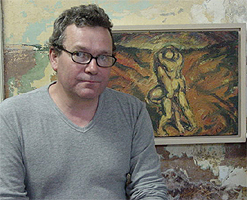
 | Chris Wyatt |
Chris Wyatt paints figures in landscape in an epic style. He is always concerned with the large social and moral issues of his time. His figures are often postured in symbolic forms, torn between divergent motivations, in times of crisis. Wyatt thinks of these times as archetypal. His figures are situated in various perennial "moments", as he sees them, times "when we truly live". Wyatt defines these "times", such as: birth, death, love, grieving, betrayal, puberty and pregnancy, as high points riddled with uncertainty, a flux of unknowing. These are times that "mold the human spirit".
They are also times in which his subjects find themselves in paradoxical situations. In most of his subject matter we sit with very clear perceptions of such juxtapositions as: contest and passion, betrayal and merciless guilt and vicious crime and victimization. The way the figures are articulated has symbolic purpose. Their posture depicts the symbolic moment experienced by them.
13 years ago Wyatt travelled through Ireland and was swept away by the bareness of its landscape. SInce then, he has engaged with the Irish landscape because he sees it as stripped bare off all but it's most rudimentary elements, stripped by the wind and the rain. It offers him a raw environment, inhospitable. All that remains are the things of relevance - the perfect setting for the very nature of human existence. The lovers, Anita Cobby and Judas are painted in the colours, tone and spirit of this place. As observed by his agent, Terry Cutcliffe,
"Wyatt approaches his subjects in a totally uncompromising manner, producing art of great power and sensitivity." (2 November 2001.)
Wyatt feels compelled to express the events that effect him deeply in paint. These events usually consist of people in a state alientation at somepoint of nexus, often where those featured are both the victims of what they are doing and the perpetrators of the consequences.
Wyatt is a slow and persistent worker. For Wyatt, emotional thoughts find expression in intellectual statements as paintings. This process takes a great deal of time and effort. "It's not easy for me to make paintings." These ideas translate into paint through a meditative process. For example, his paintings of the Myall Creek Massacre, exhibited at the Cutcliffe Gallery during the Olympic Games, September 2000, consisted of approximately 40 pieces and took 6 years to complete. The series began with a book by Roger Milliss - Waterloo Creek, about the conquering of New South Wales. There was one episode in the book reporting on the Myall Creek massacre. Wyatt needed to put it into paint, he was compelled and commenced building what he felt into an intellectual and physical statement.
Wyatt feels that the world is heading into a 'medieval' time, where tribalism and "crank theories" hold sway. This is illustrated exactly by the events at Myall Creek. 30 people, mainly women and children, were butchered. Wyatt felt that this event needed to be grappled with by someone Anglo Saxon. What characterizes the work is that there is no clear distinction between the race of the aggressors and the intended victims. They are depictions of a mass of struggle, human against human.
Wyatt's works are enduring. Perhaps a motivation for the epic nature of his subject matter, if not the archetypal themes and enduring quality of his work is his insight that, "The cheapest chair will outlast us." We will continue to grapple as Wyatt's figures grapple with the archetypal experiences that make us who we are.
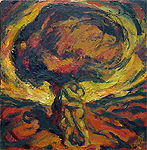 |  |
Cezanne is an obvious influence. Wyatt's figures are massive like those of their forbearers. He has been working on a series of lovers for 15 years, bather type lovers of Cezanne's spiritual and monumental proportions. Painted at an archetypal moment in people's lives "The Lovers" are the model of lovers. They are almost Platonic in their identity, an ideal form recognized by all, but they tussle like flawed people, wrestling with their passion.
Wyatt Paints with a swirling circular motion, one off at a time. This motion catches the emotive figures and knits their condition to the canvas.
His paintings are austere by nature, the colours are elemental. The colours are reminiscent of socialist poster art of the thirties. However, they are not used to cause effect, entertain or titillate. Wyatt's colour is used in a symbolist way and there are literal meanings attached to each of them. For example earth colours have obvious connotations while lemon yellow is the sky, setting the time of day and emotive moment. Blue underneath denotes the spiritual and comports a symbolic value only.
Wyatt's figure have real physicality and are depicted in poses that have a symbolic nature. Even the way the figure is articulated has a symbolic purpose, is used to depict the archetypal moment experienced by the figure.
As C�zanne's Bathers are manifestations of the spiritual human existence, so Wyatt's figures point to key elements of our condition. His primary influences include Masaccio, Byzantine painting, Giotto and Ducco.
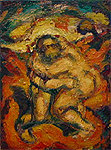
He is interested in Judas as a betrayer of Jesus. After the death of Jesus, the subject is wracked by doubt and guilt to the point of suicide. Judas truly lived at that archetypal now. The series of Judas in Ireland offered Wyatt the perfect subject for duality - as both a victim and perpetrator of a crime. Wyatt's Judas, set in Western Ireland, would come to wrestle with these two elements in himself, elements that he was fighting with.
Wyatt is identifies particularly with the work of the American poet Robinson Jeffers. "Dear Judas," is a poem that he read after beginning the Judas series. It further inflamed his zeal for transposing the subject into paint.
Wyatt shows sensitivity in dealing with man's inhumanity to man by maintaining a classical distance from his often raw subject matter. In his depiction of the rape of Anita Cobby, once one brings oneself to look directly at the work, one sees the perpetrators almost busily working at different parts of her body. Their posture and dissociation from each other, indeed their absorption in their individual tasks gives the impression of industrious construction. This reduces the painting's literal portrayal of the horrific event that shocks people even when it is mentioned today. The idea of the work it is a potent symbol in itself, especially considering the media coverage of the perpetrators of the crime. Society might be said to be responsible for their acts.
Wyatt suggests that all perpetrators of criminal acts are also victims of their act. He goes so far as to state, "If there's a victim the guilty person is also a victim." However, in the case of the Anita Cobby painting, the criminals are, as Wyatt emphasizes, "in no way victimized by Cobby." Upon consideration of the actual event depicted, focus on the these criminals as having become twisted "because of society" abnegates the significance of the victim of the murderous rape. She is innocent, not participating in the dynamics of victimizing the young men concerned. Consideration of the criminals as victims is especially interesting in light of the fact that Anita Cobby is the only person's name associated with the work.
Does this painting say: look at how horrible our society really is? When looking at this picture, it is not the notion of how horrid some people become in the course of the lives, and what they do that horrifies me. In the case of a painting that depicts the mutilation of a woman, no matter how stylized, it is the painting itself that is in question.
The painting of the rape of Anita Cobby stops at being a depiction of the mutilation of a woman at the hands of men industriously working at what they do - like an early Cezanne. This is an act that abnegates Cobby's worth as a human being, in a sense perpetuating the relegation of her life to "prop" for the theatre of victimization of the killers. The Cobby figure even looks lost and mournful for our benefit, like a bereaved mother painted by the Heidelberg school. I find it offensive.
The painting will be on display at the Casula Powerhouse at the Anita Cobby Show in February 2002.
Have your say: here.
Wyatt has always got work at the Cutcliffe Gallery.
 |
 |  |